#3 Context, Memory, and the Cost of Not Reading Anymore
RFCs are back: how developers are planning around AI's blind spots
Developers (including myself) are getting increasingly passive, letting AI write code without thinking deeply about architecture or implementation details, and that rush from planning straight to execution ends up disconnecting the code from the actual business rules. To fight this, RFCs and written technical specs are becoming the new 80/20 rule of software development: instead of jumping into execution, the idea is to spend roughly 80% of the time planning, defining requirements, and writing RFCs, and only 20% actually coding.
Without a well-defined spec, autonomous AI agents can easily generate code that breaks the application's architecture or domain rules, so the RFC becomes the source of truth that keeps everything aligned. Discussions around raised an interesting point: technical specs should be language-agnostic. By rigorously documenting inputs, outputs, and validation rules in Markdown, AI can port the same architecture to other languages, like Go, TypeScript, or Rust, without friction.
Since many developers hate writing long specs, there's a workaround: the "Grill Me" skill, originally created by Matt Pocock, which has been gaining a lot of traction. Using a customized version of this prompt, the AI relentlessly questions the developer about implementation details and business logic before writing a single line of code, so the developer actually understands the rules being built instead of having to read through thousands of lines of AI-generated code. Planning through RFCs is essential, but it doesn't replace code quality: static analysis, linters, strict quality gates (like limiting function and file size to force modularization), and automated evals are still indispensable.
mattpocock/skillsSkills for Real Engineers. Straight from my .agents directory.GitHubSatya Nadella's "Reverse Information Paradox" and the hidden cost of using AI
Microsoft CEO Satya Nadella has coined a term for a quiet cost of enterprise AI: the "Reverse Information Paradox." Drawing on economist Kenneth Arrow's classic Information Paradox, where a seller struggles to prove the value of information without giving it away for free, Nadella argues that generative AI flips this dynamic onto the buyer. To get real value out of a model, enterprises end up disclosing their own proprietary knowledge, processes, and institutional expertise, so in his words, companies "pay for intelligence twice, once with money, and again with something even more valuable: the proprietary knowledge" they must reveal to make the AI useful. According to Nadella, every prompt, correction, and evaluation an employee runs contributes to what he calls "intelligence exhaust," meaning organizations are constantly training the very systems they're paying to use, often without capturing any of that accumulated learning for themselves. His proposed fix is for companies to build a clear trust boundary around their own tenant, keeping organizational memory, prompts, and evaluation systems inside their own infrastructure rather than letting that knowledge leak out to the model provider by default. Critics have pointed out the irony here too, since Microsoft is both warning about this risk and one of the biggest beneficiaries of enterprise AI adoption through Azure and its stake in OpenAI.
Microsoft CEO Satya Nadella warns of 'Reverse Information Paradox' facing businesses in AI AgeMicrosoft CEO Satya Nadella discusses the challenges businesses face in the AI age, particularly the 'Reverse Information Paradox', where buyers risk giving away proprietary knowledge to leverage AI models. The article emphasizes the need for enterprises to establish trust boundaries and control…ETEnterpriseai.com
OpenAI's first hardware product is a tiny keyboard for controlling AI agents
OpenAI has rolled out its first hardware product, and it's not the consumer device everyone's been expecting. The company teamed up with Work Louder, a maker of programmable keyboards and macro pads, on a $230 device built specifically for its coding agent Codex.
Technically it's more of a macro pad than a full keyboard, officially called the kbd-1.0-codex-micro, or Codex Micro. It packs 13 mechanical switches, a touch sensor, a rotary dial, and a joystick, and ships with 32 customizable Codex icon keycaps. Six illuminated keys change color to show an agent's status: green means there's an unread message, blue signifies thinking, orange means an agent needs approval or has a question, and red means an error has occurred.
The joystick can be programmed to trigger workflows like debugging or refactoring code, while the dial adjusts how much reasoning Codex applies to a task. The launch comes as speculation grows around OpenAI's actual flagship hardware device, reportedly a screenless smart speaker being developed with Jony Ive's team, expected to be announced by the end of the year. For now, though, this tiny keyboard is the only physical OpenAI product you can actually buy.
OpenAI Just Launched Its First Hardware Product—and It’s a Tiny Keyboard for Bossing Around AI AgentsThe AI company teamed up with Work Louder on a programmable keyboard designed specifically for Codex.Gizmodo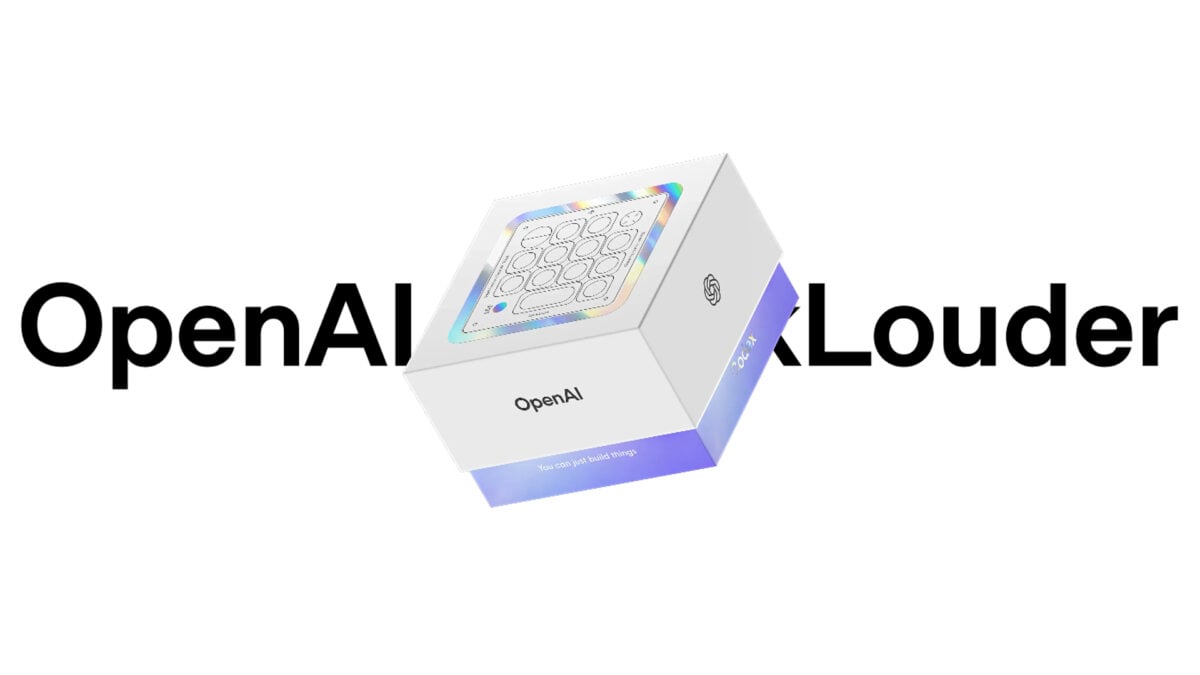
Google introduces the Open Knowledge Format for AI agent context
Google Cloud just introduced the Open Knowledge Format (OKF), an open spec aimed at a very real problem: AI agents don't actually know your business. Ask an agent "how do we calculate weekly active users," and it has no way to find that answer, because that knowledge is scattered across wikis, spreadsheets, code comments, and the head of one engineer who's been there for years. OKF fixes this by giving teams a simple, shared way to write that knowledge down, as plain markdown files that any AI agent can read, without needing special software or a specific vendor. Each file describes one thing, like a table or a business metric, and links to related files, so the whole thing behaves like a living, growing wiki built for both humans and AI to use. Google's already using it internally and has open-sourced the spec on GitHub for anyone to try.
How the Open Knowledge Format can improve data sharing | Google Cloud BlogLearn how the Open Knowledge Format helps secure data sharing and improves collaboration across teams with standardized documentation.Google Cloud Blog
Hindsight: a memory system built for AI agents
Hindsight is an open source memory system from Vectorize designed to solve a problem most AI agents still struggle with: they forget everything between sessions. Every new conversation starts from zero, with no context about who you are or what's already been discussed, and simple vector search doesn't fully solve this, since questions like "what did Alice do last spring" require reasoning about time, not just semantic similarity. Hindsight stores raw facts and automatically consolidates related ones into higher-level "observations," so an agent can build up durable, evidence-backed knowledge over time instead of just piling up repeated memories. Retrieval runs four strategies in parallel, semantic, keyword, graph, and temporal, so it can handle everything from exact names to indirect connections to time-based queries. Memory banks can also be configured with a mission, hard directives, and softer reasoning traits, shaping how the agent uses its memory rather than just what it retrieves. It's available as Python, TypeScript, Go, CLI, and HTTP clients, with integrations across most major coding agents and agent frameworks.
Overview | HindsightState of the art long-term memory for your agents. Hindsight gives AI agents memory that learns across sessions.hindsight.vectorize.io
Opinion: thinking is becoming a luxury good
I came across this interesting article, published in 2025 yet still relevant, by Mary Harrington, and it's stuck with me since.
Her core argument is that our capacity for long-form reading and reasoning is quietly turning into a class marker. She points to evidence that adult literacy scores have declined across most OECD countries over the past decade, even as smartphones and short-form video have taken over how most people consume media. The comparison she draws to junk food is a good comparison: just as ultraprocessed snacks created a divide between people with the resources to eat well and those without, she argues digital media is creating a similar split, between people who retain the capacity for deep, linear thought and a much larger group drifting toward what she calls post-literacy.
Besides that, she cites a relevant piece of data on kids: children from lower-income households already spend significantly more screen time than wealthier peers, and heavy recreational screen time correlates with weaker working memory, attention, and executive function. Meanwhile, it's the elites who are opting out, sending their kids to classical and Waldorf schools built around "great books" literacy, or limiting screens at home the way some tech executives openly do.
The critical part is her political read on it. A population that loses the capacity for sustained reasoning becomes more tribal and easier to manipulate, and that cuts across the political spectrum. Does it sound a big problem, doesn't it?