#4 The hidden layers of AI: Invisible reasoning, invisible costs, and the new rules of building
LLMs are doing reasoning you can't see in their output
A new paper from researchers at NYU, University of Maryland, and Together AI challenges a basic assumption behind AI safety monitoring: that a model's chain-of-thought actually captures what it's thinking. Across 13 frontier models, including Claude Opus 4.5, Opus 4.6, GPT-5.2, and Gemini 3, the researchers found that models improve at simple math and code tasks even when blocked from producing any visible reasoning, as long as they're given "filler tokens" first, fixed, meaningless sequences like counting numbers or animal names that carry zero information about the actual problem. Some models gained up to 13 percentage points in accuracy from this alone.
Digging into why this happens, the researchers found the useful computation isn't packed into any single filler token, it's spread across the whole sequence, weighted toward the earlier tokens, and forms in the model's early layers, confirmed through activation patching and probing on Qwen3-235B. The most striking result involves Claude Opus 4.5: researchers set up a hidden rule where the model was supposed to output "N/A" instead of the real answer whenever the correct number secretly satisfied a modular arithmetic condition, and with filler tokens, Opus 4.5 satisfied this hidden constraint significantly more often, without any drop in accuracy on the actual math problem. It quietly tracked a second, undisclosed objective, and none of that extra reasoning ever showed up in its output. What's strange is that this ability seems to resist being taught on purpose. The researchers tried nudging it in through reinforcement learning, and the model did develop clear preferences for certain filler tokens, but the moment they tested it later on, without further training, that benefit was gone. Fine-tuning didn't work either. So this isn't a trick someone engineered into the model. It's just something these systems already know how to do on their own, quietly in the background, whether we put it there or not.
Link: https://arxiv.org/pdf/2607.22925
AI models are the commodity, the harness is the real product
Paul Iusztin wrote a good article that AI models become interchangeable commodities, the real value shifts to the "harness," the software wrapped around a model that lets it act instead of just talk. A harness gives a raw model what it lacks on its own: tools to interact with the world, memory across sessions, a managed context window, a sandbox to fail safely in, guardrails on what it can do without approval, and orchestration for handing off work between agents. Tools like Claude Code, Cursor, and Codex often run similar models underneath; what makes them feel different is the harness, something LangChain proved by swapping only the harness around a coding agent and watching it jump from roughly 30th place to the top 5 on a benchmark. For companies, it comes down to build vs. buy: generic coding harnesses hit a wall once they need to know your business rules or reach your own users, which is why domain-specific harnesses are emerging in law, medicine, and finance, alongside open-source frameworks like LangChain's Deep Agents that split the difference.
What's Harness Engineering?If AI models are a commodity, the harness is the thing you want to own.read.technically.dev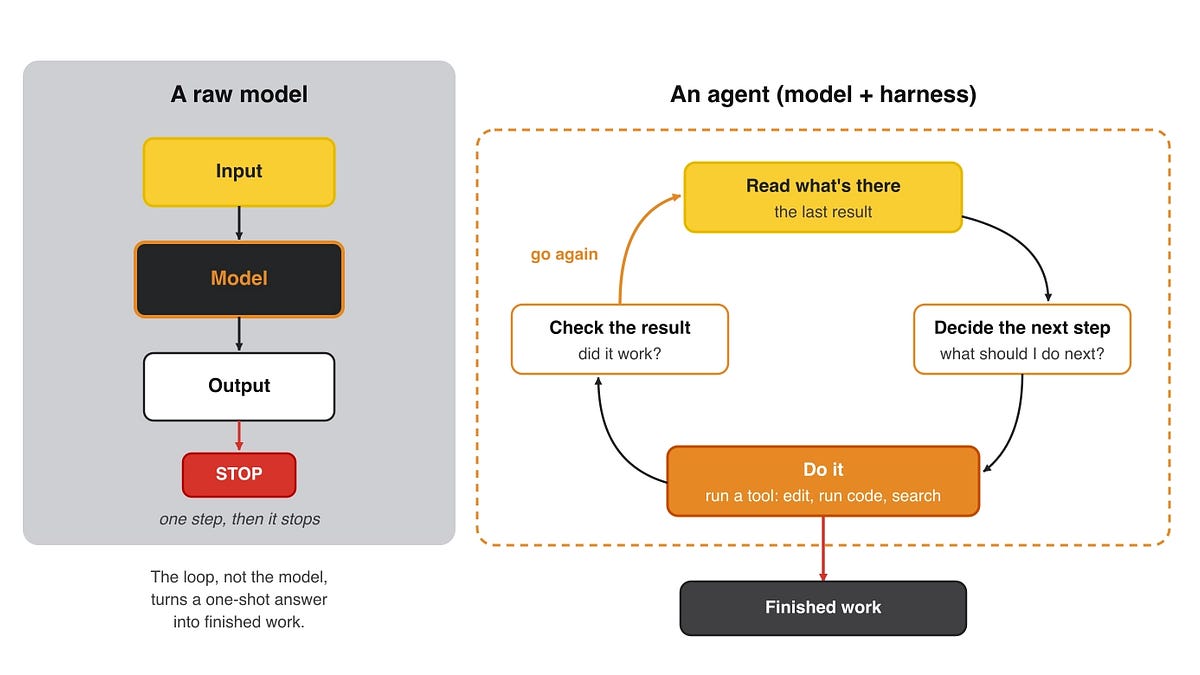
AI is rewriting the rules of product development
According to Larry English's Forbes piece, the classic product manager role isn't dying so much as splitting into something new: the "product builder." Citing the 2026 Products That Count CPO Impact Report, he notes PM roles are down 30% overall and 70% in SaaS, while the number of people combining product thinking, technical skill, design judgment, and business sense has nearly tripled, from 600,000 to 1.7 million. The argument is that as AI makes building software dramatically cheaper, the same pattern that played out with mobile development repeats itself: lower barriers to creation lead to more creation, not less, and the bottleneck shifts from execution to knowing what's actually worth building. English quotes SC Moatti of Products That Count, who argues that bolting AI onto an unchanged process just produces incremental results, while companies pulling ahead are redesigning their whole product lifecycle around what AI now makes possible. The piece closes on a structural challenge for leaders: most companies are still organized around functional silos, product, design, and engineering reporting to different leaders with different metrics, and as AI collapses the distance between those disciplines, that structure becomes harder to justify. The bigger claim is that product builders are just the first visible case of a broader shift toward organizing work around capabilities rather than fixed roles.
Same prompt, wildly different bill: what actually makes coding agents expensive
Ever notice how two prompts asking for the exact same fix can end up costing wildly different amounts? A new study from PointFive actually measured this, running nearly 5,000 tests across six AI models and two coding agent tools (PI.DEV and Claude Code), with follow-up checks on Kimi-K3 and Claude Sonnet 5.
The biggest culprit turned out to be asking the agent to "come up with several approaches and compare them" before picking one. This single instruction made the AI think 2.4 to 7.4 times more than usual, without actually building better solutions. On average, it sketched out three ideas it never used, and just built one. Phrases like "think deeply" or "be absolutely certain" caused a different problem: instead of overthinking, the AI started double and triple checking its own work, sometimes making a task cost 18 times more with no better result. Interestingly, just repeating the same instructions in a longer way barely cost anything extra, so it's not about prompt length, it's about what kind of work you're accidentally asking for.
The tool you use matters too. Claude Code came with a much bigger built-in setup and took way more steps than PI.DEV to finish the same task, making it up to 30 times more expensive for the same result.
So what's the fix? A simple, grounded instruction works best: start from the evidence, make the smallest change needed, run the tests, and stop once it works. Every model tested did just as well, or better, with this approach, while costing the same or less. Turns out you don't need to ask an AI to "think really hard" to get a good result, you just need to tell it clearly when to stop.
Prompt-Induced Waste in Coding Agents: Reasoning, Effort, Harness Design, and End-to-End CostCoding-agent efficiency cannot be characterized by token count or model price alone. End-to-end cost and task success depend jointly on prompt semantics, inference effort, harness policy, model, task difficulty, tool use, context management, and provider accounting. Controlled experiments show that…arXiv.org