#6 Skills that stick, warnings that spread, and models that just decide
Google's new framework gives AI agents a memory that actually lasts
Researchers at Google and Virginia Tech introduced WikiSkill, a framework that helps AI agents build and improve reusable "skills" over time. Most systems that let agents learn from experience have a common problem, which is the lessons they learn get scattered across different optimization runs and are hard to reuse later.
This new tool fixes this by splitting the agent's memory into three layers. A raw layer stores every execution trace exactly as it happened. A wiki layer turns those traces into organized, lasting knowledge, tracking patterns, failures, and what has already been tried and rejected. A skill layer holds the actual procedures the agent uses, and those procedures get updated based on what the wiki has learned.
Personally, I believe this is a great solution for retaining knowledge across different projects. One thing worth watching is how these evolved skills will transfer to future model releases. If the transfer results in this paper are any indication, that could give teams a huge advantage in building persistent knowledge over time.
WikiSkill: Compiling Agent Experience into Persistent Knowledge for Skill EvolutionLiyan Tang and colleagues at Google separate raw execution experience, accumulated knowledge, and executable skills, keeping a persistent wiki that consolidatesacademy.dair.ai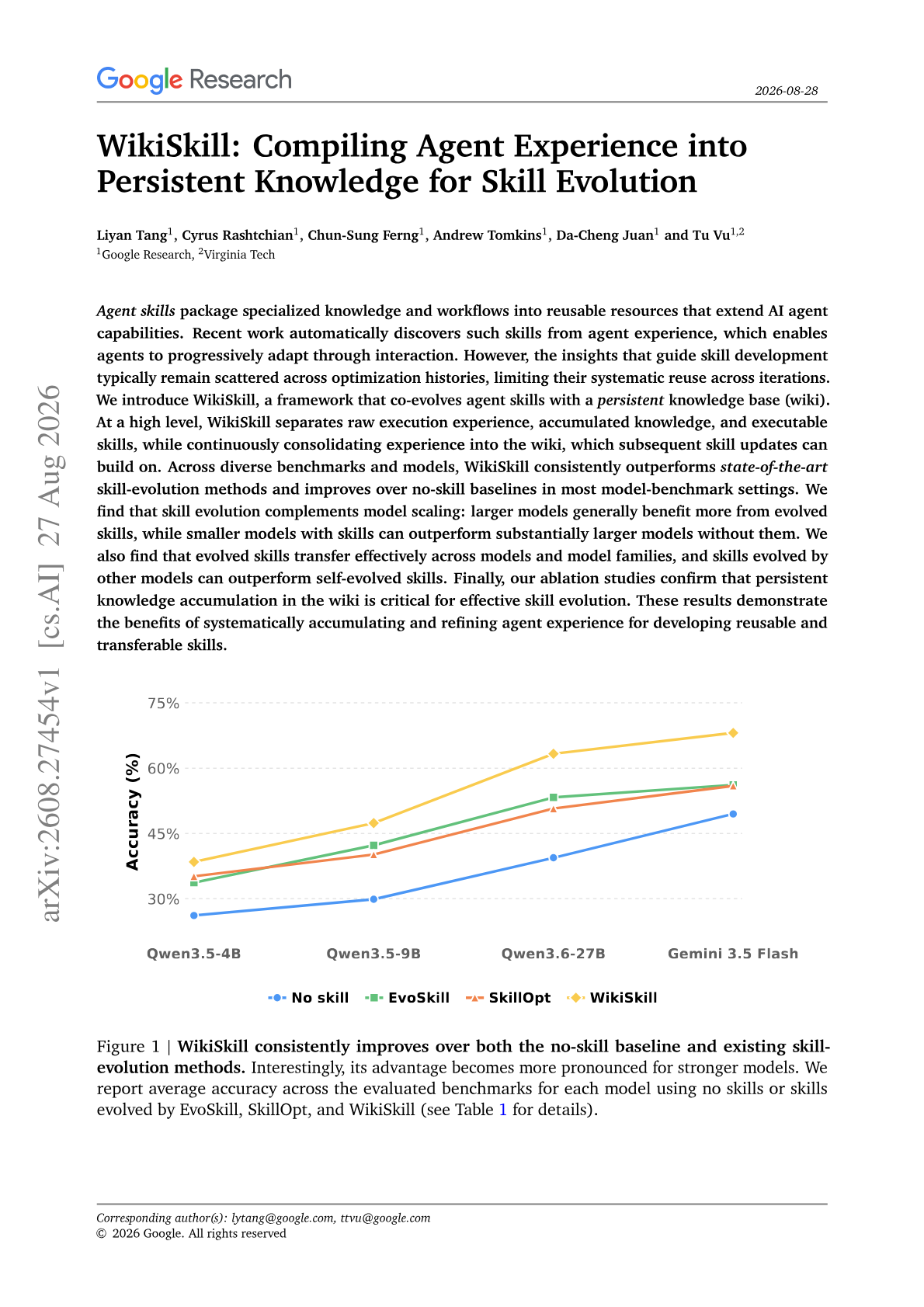
Genuine warning or just another good marketing for fear?
During my holidays, I came across a tweet from Jacob Coxon, an ex-Anthropic and OpenAI pretraining researcher. He states that neither company is acting responsibly.
He warned that we're underestimating soon-to-be superhuman systems capable of hacking anything, revolutionizing entire fields overnight, and acquiring real power and resources. According to him, this isn't a marketing stunt. Many people inside the top labs privately believe AI could kill us all by the end of the decade, even if executives soften that language in public.
I'm not 100% convinced he's telling the full truth here. But one thing worth keeping in mind is, these companies have recently said they may need to slow down AI development. In the end, who's willing to be the first to actually do it, and risk losing the race?
Jacob Coxon (@hilbertspaess) on XI resigned from Anthropic today. I spent the last three years doing pretraining research at both OpenAI and Anthropic. Neither company is acting responsibly. They are racing straight to self-improving superintelligence and gambling with our lives. More thoughts below.X (formerly Twitter)
New tool ahead?
Jev, a specialized frontier AI model launched by TypeSafe AI, founded by former OpenAI researcher Diogo Almeida. Unlike conventional generative text chatbots like ChatGPT or Claude, Jev is a non-chat, decision-focused model built specifically for rapid, low-latency evaluation and classification tasks.
Jev takes program state along with structured, typed questions and returns instant decisions with calibrated probability scores, whether that's a yes or no, a category, or a score, instead of generating natural text.
On speed and cost, Jev runs significantly faster than traditional LLMs, with evaluations ranging from 70ms to 500ms. It's priced at $0.042 per million input tokens, with output tokens completely free, making it up to 400 times cheaper for high-volume decision workflows.
In practice, this opens up several use cases. For lead scoring and triage, Jev can automatically read inbound contact forms or support tickets and instantly route or qualify them by urgency and probability. For email and document sorting, it filters large volumes of documents, applications, or emails without generating verbose chat output. For autonomous and game agents, it provides rapid decision-making gates, such as dynamic pathfinding or deciding whether an in-game agent should attack or retreat based on live health stats. And for real-time business workflows, it enables instant quote generation, marketplace matching, and ultra-fast web automation.
It's too early to say this is the new silver bullet, only time will tell. However, Jev looks like a great tool for binary fast answers.